
Spotting Problems Before They Cost You: Risk Planning for Small Teams
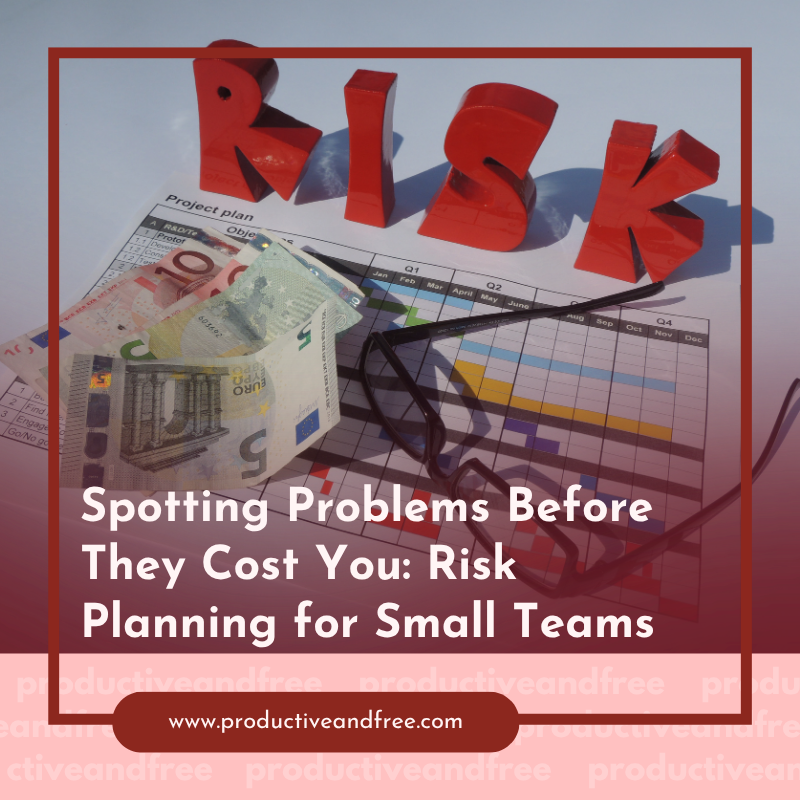
Ever watched a small project fall apart over something nobody saw coming?
It happens all the time. You lose communication with a supplier. A key team member resigns. One approval languishes in someone's inbox for three weeks. Suddenly the deadline passes, the budget is lost, and panic ensues.
Here's the frustrating part...
Most of those problems were evident weeks before they happened. No one wrote anything down, so no one took care of them.
Risk planning eliminates this problem. Best of all, it doesn't require a large staff, costly software, or a dedicated project office to do it right.
What this guide covers:
Why Small Teams Feel Risk Harder
What Risk Planning Actually Involves
How To Spot Risks Early
Scoring, Owning And Reviewing Risks
Why Small Teams Feel Risk Harder
Big companies have layers of protection... Small teams don't.
If a five-person team loses one member for two weeks, they've just lost 20% of their entire workforce. There is no bench. There is no back-up department quietly fielding work. Every issue that comes their way magnifies because there is so little capacity to absorb it.
The statistics aren't pretty. Research from Accenture revealed that 92% of capital projects fail to meet time and budget goals. Those who fail over-run by an average of 29%, with only 6% delivering on time and budget or better every time.
The good news for small teams?
These aren't personality traits. Many team leads learn them by earning an online project management certificate rather than the alternative: 10 torturous years of on-the-job training. A Graduate Certificate in Project Management online covers risk identification, scheduling, budgeting and stakeholder management at a time that works for you, even if you have a full-time job. Structured project management training from a course like this replaces guesswork with a repeatable process that anyone can follow.
Which is really the whole point of risk planning.
What Risk Planning Actually Involves
Risk planning makes you think of some corporate meeting with 40 page documents stapled to it. It doesn't have to be.
Strip it back and it's four questions:
What could go wrong?
How likely is it?
How badly would it hurt?
Who is dealing with it?
Honest answers to those four questions at the start of a project put your team ahead of most competitors. Honest answers once a week and your team becomes very difficult to derail.
Risk planning is NOT trying to guess the future. No one can do that. Risk planning attempts to ensure that predictable problems never become surprises.
80% of the things that kill little projects are mundanely foreseeable. Late schedules. Scope that's not defined. Knowledge silos. Approvals that drag their feet.
Those are not black swans. They're patterns.
How To Spot Risks Early
So where do these risks hide?
They usually occupy the same handful of seats for most projects. Set aside an hour at the beginning. Go through this list with the team and jot down any ideas.
Reflect on your past three projects. What happened? If it hurt last time it will probably hurt again.
Audit all dependencies. Whatever has to happen outside the team before the team can progress is a risk. Vendors, customers, other teams, contractors.
Identify the single points of failure. If someone is the only person who knows how something works, that's a risk with legs.
Put estimates under scrutiny. If something has a guessed rather than measured due date, it should be red flagged.
Ask the quiet people. The one building knows what is wobbly. They just haven't been polled yet.
The most important one above is often overlooked. Risk workshops don't work if the biggest personality dominates.
Stay casual. No need to point fingers yet -- you're just identifying issues while they are little and inexpensive to solve.

Score Every Risk (Because They're Not Equal)
Now comes the part most small teams skip.
A list of 30 risks does nobody any good. No one has time or attention to concern themselves with that many things. They each need to be scored.
How it works: Score each risk twice out of 5.
Likelihood — how probable is it?
Impact — how much damage would it do?
Multiply them together. If a risk scores a 20 it gets attention today. A risk scoring a 3 gets placed on the list and ignored until something changes.
It really is that simple.
This matters because risk begets risk. McKinsey studied more than 300 megaprojects and found cost overruns near 80% and schedule slippages of around 50%. These projects typically cost billions of dollars and have armies of experts. You have a budget of five salaries and a client saying 'it needs to be done'.
Focus on the top five. Everything else can wait.
Give Every Risk An Owner
A risk owned by "the team" is a risk owned by nobody.
Assign one name to every risk in the top five. Not a department. Not a title. One person who owns that risk and is watching for movement.
The owner doesn't need to solve the problem by themselves. It's actually much easier for the owner. Their responsibility is just this:
Watch for early warning signs
Flag it the moment things shift
Own the agreed backup plan
And that's where the backup plan comes in. What happens if one of your top risks does land? Decide ahead of time, as a team, what task will get dropped. Who will get called. What the client will be told.
Decisions made under pressure in week nine should have been made weeks ago.
Review The List Every Week
Risk registers aren't audited unless something goes wrong. Someone lovingly crafts a spreadsheet during kick-off. By week four no one has looked at it.
Don't let that happen.
Add ten minutes to the weekly team meeting and run through three things:
Has anything on the list got more likely?
Has anything new appeared?
Can anything be closed off?
Ten minutes. Per week. That's all it should take for a small group to continually plan for risk. That's the gap between discovering an issue during week three or week ten.
Projects don't die dramatically. They fade away slowly after a series of tiny warnings signs that everyone saw but no one reacted to.
Putting It All Into Practice
Risk planning doesn't just produce paperwork. It is the least expensive insurance you will ever purchase.
To recap the process:
List everything that could go wrong
Score each risk on likelihood and impact
Focus only on the top five
Give every one of them a named owner
Agree the backup plan before it's needed
Review the list for ten minutes each week
Small teams can't afford large scale mistakes. Nor do they have sufficient headcount to absorb their impact. However, they do have one advantage over big business. They can identify an issue Monday, and correct it by Tuesday.
Use it.























Share in the comments below: Questions go here
Ready to launch your dream business? Explore essential tips for finding the perfect opportunity that fuels your entrepreneurial ambitions.