
How to File a Utility Patent
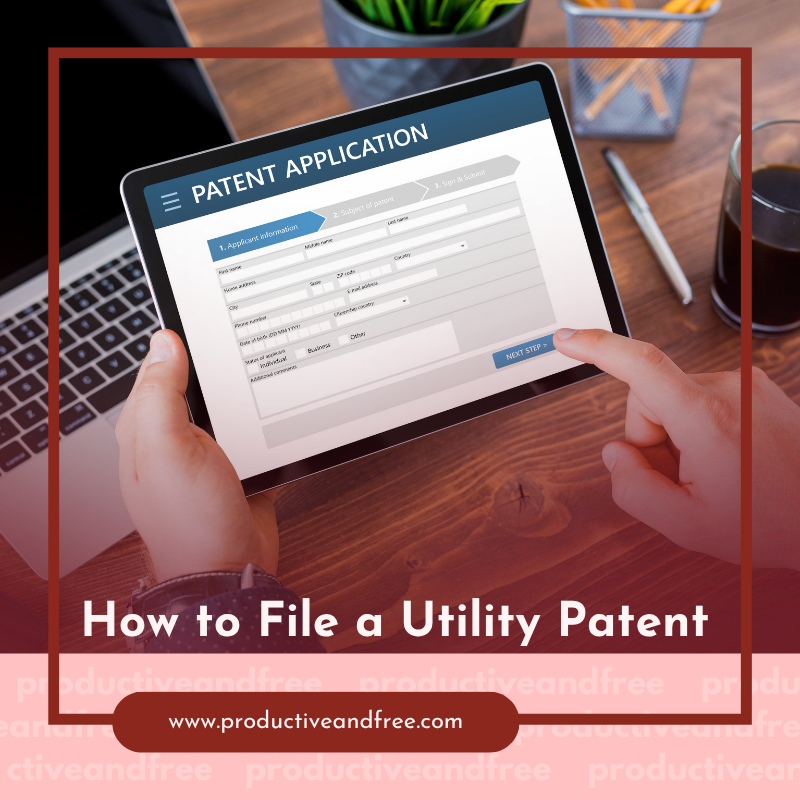
The most common type of patent filed in the USA is the utility patent. The number of utility-dependency applications filed in the USPTO every year ranges in the hundreds of thousands. In the past few years, the USPTO has granted more than 300,000 patents each year.
Executing a utility patent refers to the means under U.S. patent law of shielding a new and useful invention, process, machine, or technological improvement. Acquiring a utility patent privilege gives the inventors the right to produce, utilize, and trade the invention for a specific duration, usually twenty years after the day it was presented.
Normally, the first steps include researching whether your invention is new globally, putting in writing detailed and illustrated descriptions, formulating patent claims, and sending the documentation to the USPTO.
These figures suggest that utility patent protection is important for inventors and businesses that intend to innovate, attract investment, and maintain a position of leadership in the market. These effects highlight why every business and inventor wants to obtain patents for their inventions.
Let’s examine how to file a utility patent compliant with USPTO regulations and the factors that can affect the success of one’s application.
Confirm Your Invention Meets the Three Patentability Requirements
Before the filing process can be initiated, a claim must fall under the provisions of 35 U.S.C. §§ 101–103 where the invention is subjected to three patentability requirements.
● It is necessary that your invention not be disclosed, patented or sold in any way before you file a patent. According to the America Invents Act, it is possible to use a one-year grace period for your disclosures. There is one major restriction to this rule: any prior art published by someone else before you filed your patent will invalidate your attempt to establish novelty.
● The new invention must be new and non-obvious to a person who holds ordinary skill in the relevant field. The most subjective requirement among the three present needs to prove its legitimacy through testing during examination.
● The invention needs to demonstrate a practical application that has both specific and significant value. Applications that are merely speculative ideas or theoretical concepts do not meet qualification standards.
Patent protection excludes abstract ideas, natural phenomena, and laws of nature even when they meet the three established criteria. The Supreme Court's decisions in Alice and Mayo have resulted in broad application of this exclusion to software and biotechnology legal cases.
A skilled patent attorney can easily check your invention for compliance with these requirements. According to the law firm website https://www.fourreasonslegal.com/, when you hire an experienced attorney, you can reduce the time and energy necessary to get a patent and instead focus on your business and any personal responsibilities.

Run a prior art search using USPTO and international databases
A prior art search identifies existing patents and publications that could block or limit your claims. Filing without one is a common and expensive mistake. The USPTO’s Patent Public Search tool allows users to search U.S. patents completely free of cost in full text and full image. The Google Patents search engine indexes the various international patents, such as those filed with the European Patent Office, WIPO, etc.
Conduct searches using search queries, keywords, and Boolean combined searches, any valid Cooperative Patent Classification (CPC) code(s), and any inventor’s name. Read the claims sections carefully, not just the abstracts. The claims of a patent establish its legal protection limits. Your patent will have potential if it contains narrow claims. Your patent will have potential if it contains broad claims.
The search results provide two options when they show prior art: you can change the invention to make it distinct or you can decide whether patent protection suits your needs better.
File a Provisional Application to Lock In Your Priority Date
A provisional patent application does not undergo examination and it cannot become a patent on its own. The application serves to create a priority date, which lasts until you finish your complete nonprovisional application.
The timeframe for non-provisional application submission starts with the provisional filing date and lasts for 12 months. If you do not submit your application within that period, you will lose both the provisional application and the right to the earlier application date.
Provisionals do not require formal claims or an oath. One section of the document should show a detailed description that will support the future non-provisional application. An incomplete provisional patent application may lack provisions for some features that the first application does not include.
In some cases, the USPTO requests the inclusion of drawings pertaining to the invention in the application if they are important so key relevant drawings must be attached.
Prepare the Nonprovisional Application: Required Components
The USPTO Patent Center requires that all nonprovisional utility patent applications include the following components:
● Specification: A written description covering background, summary, detailed description, and best mode of carrying out the invention. This section functions as the technical core of the patent application.
● Claims: At least one claim that defines the scope of protection. The independent claims establish the widest protection, while the dependent claims establish more specific boundaries. The application includes multiple claim components but their most critical element will face review during the examination process.
● Abstract: A brief technical summary, 150 words or fewer.
● Drawings: The invention requires black-and-white line drawings that provide better understanding to readers. The approval process for color drawings in utility applications needs a petition, which results in very low approval rates.
● Oath or Declaration: A signed statement by the inventor(s) that they believe themselves to be the original inventor of the claimed subject matter. Use USPTO Form PTO/AIA/01.
● Application Data Sheet and Transmittal Form: Cover documents that identify the invention type and applicant and list all enclosed components.
The specification claims and abstract need to be in the DOCX file format to prevent the $430 fee, which applies to big organizations after January 17, 2024. The Patent Center allows electronic filing, which eliminates the $400 fee that applies to paper-based submissions.
Understand What Happens During Examination
After filing, the application is assigned to a patent examiner in the relevant technology center. The examiner reviews the specification, conducts an independent search of prior art, and produces a written document that the Office Action assigns to him. The USPTO reports that roughly 92 percent of applications receive at least one rejection before a patent is granted.
An Office Action does not function as a denial. It presents an examiner who evaluates the patentability requirements, which the claims currently fail to satisfy. The applicant typically has three months to respond, which can be extended to six months through a payment. The responses can contain both arguments and claim amendments or they can include only one of the two elements.
The applicant has two options for response after receiving two rejections based on identical reasons that the examiner still maintains. The Court of Appeals for the Federal Circuit and federal district courts serve as the two appeal options for parties who wish to challenge decisions made by the Patent Trial and Appeal Board (PTAB).
Fee Discounts That Most Individual Inventors Overlook
The USPTO filing fees receive a 60 percent reduction for small entities, while microentities receive an 80 percent fee decrease. A small entity refers to a business with fewer than 500 employees, a nonprofit organization, or an independent inventor. Microentity status requires that the applicant have filed fewer than four previous patent applications and meet income limits set by the USPTO.
The discounts apply to all filing fees, search fees, examination fees, and issue fees. The utility application presents material savings when its total undiscounted fees start at $2,000 at filing and continue to grow during prosecution. The applicant must check eligibility before filing and must confirm the accurate status through the transmittal form.
Claims Are What You Are Actually Protecting
The specification tells the story of your invention. The claims describe legally protected aspects of your work. A well-written specification with poorly drafted claims provides weak protection. A competitor who can design around your claims can manufacture something functionally identical to your invention without infringing the patent.
Inventors often have difficulty completing patent applications correctly, especially in the part where they claim various features of the invention. Some inventors try to cover every possible aspect, but they end up with very complicated claims. In some cases, the patent claim is very simple and is vulnerable to having its protection limited to that simple form. This situation presents a fundamental contradiction that professional inventors must address in a creative manner.
The USPTO provides a Pro Se Assistance Program for inventors who file without an attorney, which includes free access to legal clinics at numerous law schools. The examiner decides your application results based on the submission you make with or without legal representation.






















Share in the comments below: Questions go here
Maximize productivity by streamlining your field operations. Explore effective solutions that drive efficiency and elevate your team's performance!