
5 Ways Better Food Labeling Printer Can Improve Restaurant Kitchen Efficiency
If you've ever worked in or managed a busy restaurant kitchen, you know that small breakdowns in communication can cause big problems. A mislabeled container, a missing date, an unlabeled batch of prepped ingredients — none of these seem like a big deal on their own. But add them up across a full service, and you're looking at wasted food, confused staff, slower prep, and potential food safety issues.
Better food labeling is one of the simplest fixes available to restaurant operators, and it doesn't require a major overhaul. It just requires consistency, which is exactly why more kitchens are moving from handwritten labels to dedicated label printers that print the same format every time. According to the USDA, food waste is about 30-40 percent of the total food supply, and much of it comes down to poor inventory tracking and unlabeled or mislabeled containers.
Here are five specific ways better labeling makes a kitchen run more smoothly.
1. Staff Spend Less Time Guessing
When containers aren't labeled properly, staff have to figure out what something is, when it was made, and whether it's still good to use. That takes time. In a fast-moving kitchen, those few extra seconds per container add up quickly across a full prep or service.
Clear, consistent labels remove the guesswork entirely. Every container tells its own story: what's inside, when it was prepped, and when it expires. Nobody has to stop and ask. Nobody has to open five lids to find what they need. The kitchen just moves faster because the information is already there.
2. Food Rotation Becomes Automatic
First-in, first-out is the rule every kitchen knows but doesn't always follow. The reason it breaks down is usually simple: containers aren't dated clearly, so staff use whatever's closest rather than whatever's oldest.
When every prepped item has a clear, printed date on it, rotation stops being a judgment call and becomes automatic. Staff don't need to rely on memory or experience to know which batch goes first. The label tells them. This matters especially in high-turnover kitchens where new team members are still learning the ropes and can't always make the call on their own.
3. Prep Time Gets Faster and More Consistent
A well-labeled kitchen is a more organized kitchen, and an organized kitchen preps faster. When ingredients are clearly identified, staff don't waste time hunting through containers or double-checking contents. They can move directly from task to task because the information they need is already visible.
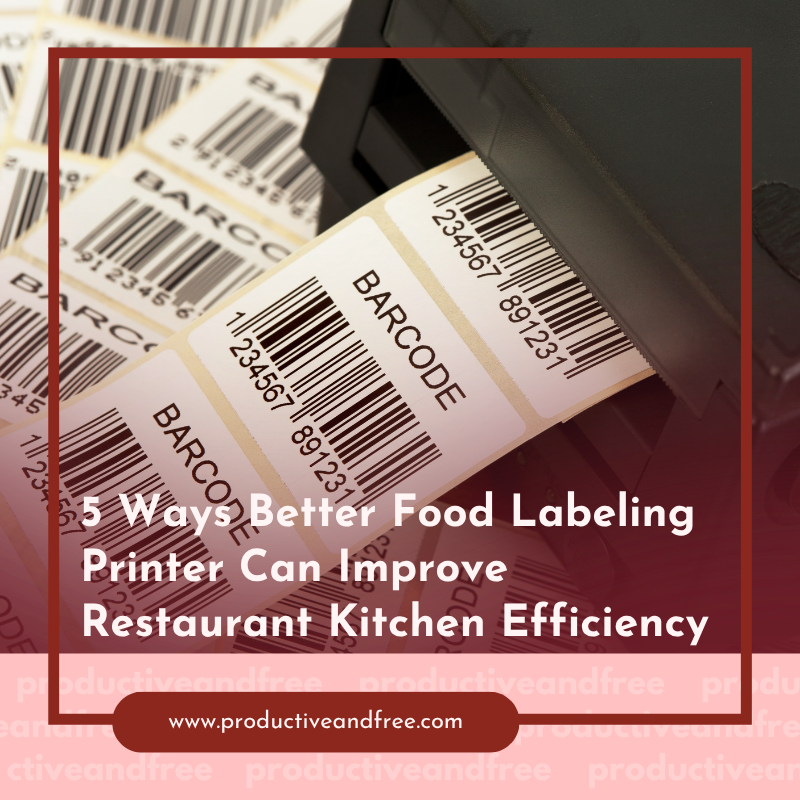
The challenge with handwritten labels is that they slow everything down. Finding a marker, writing clearly under pressure, making sure all the right information is included, and hoping the tape actually sticks — none of that is fast or reliable when a kitchen is busy. That's where a food prep label printer comes in. It's a dedicated device that prints adhesive kitchen labels on demand, complete with prep dates, use-by times, contents, and allergen information, in a matter of seconds. Every label comes out in the same format every time, regardless of who's working the station or how busy the shift is.
Some labeling platforms like Label King Turbo combine food label printing with temperature monitoring and portion control tools, which means labeling feeds into a broader kitchen management system rather than sitting as a standalone task.
4. New Staff Get Up to Speed Faster
Training new kitchen staff is one of the most time-consuming parts of running a restaurant. A well-labeled kitchen reduces that burden significantly. When everything is clearly marked with consistent formatting, new team members can follow the system without needing to ask constant questions or rely on someone walking them through every step.
This also reduces the risk of mistakes during the training period. A new hire who doesn't know what's in an unlabeled container has to guess, check with a senior staff member, or skip it entirely. Handwritten labels make this worse because legibility varies from person to person and information gets left out when things are busy. With a food label printer, fields come out consistently every time in the same format, so a new team member can read the label and act on it confidently without confusion or errors.
5. Food Safety Compliance Becomes Much Easier to Manage
Health inspectors look closely at how food is labeled, dated, and stored. Missing dates, illegible handwriting, and inconsistent labeling are among the most common issues that come up during inspections. They're also completely preventable.
In practice, kitchens that use printed labels consistently tend to sail through inspections more smoothly than those relying on handwritten stickers and masking tape. The labeling is uniform, the dates are clear, and the system is visible. There's no scrambling to explain what something is or when it was prepped, because the label already answers those questions.
Beyond inspections, good labeling also supports allergen management. When prep labels include allergen flags alongside dates and contents, that information travels with the food through every stage of storage and service, which is exactly where it needs to be.
The Bottom Line
Better food labeling doesn't just make a kitchen look more organized. When that labeling is done consistently through a printer rather than by hand, the benefits compound even further: every label is readable, every field is filled in, and the system works the same way no matter who's on shift. It actively removes friction from the daily workflow, helps staff move faster, reduces waste, and makes training easier.
For restaurant operators who are always looking for ways to improve efficiency without adding cost or complexity, it's one of the highest-return changes available. The investment is small. The impact shows up every single shift.


























Share in the comments below: Questions go here
Ready to launch your dream business? Explore essential tips for finding the perfect opportunity that fuels your entrepreneurial ambitions.